
IT Services and Trends to Consider for Your Business Growth in 2024

What is the impact of innovation?
This is a question that has become quite popular. A question with more than one answer. However, one thing is very clear: technological innovation allows for the automation of processes, improved decision-making, and the offering of new products and services more quickly. In other words, the latest trends, such as artificial intelligence (AI) and machine learning, provide valuable insights that improve operational efficiency and responsiveness to market needs. Furthermore, they help optimize resources, reduce costs, and enhance customer satisfaction. The result? A shock of growth and competitiveness.
What is the importance of the cloud in this scenario?
As we said, in an ultra-competitive market, there's a recipe for failure: refusing to adopt technology. But... Of all the technologies out there, which is the most relevant? In our opinion, the answer is simple: the cloud. Among other things, services and products of this type provide:
Flexibility and ScalabilityCloud services allow companies to scale their operations up or down according to demand. This is especially important in a market where the ability to adapt quickly to dynamic conditions has become a key competitive advantage.
Access to technologiesPlatforms like AWS, Google Cloud, and Microsoft Azure stand out for keeping their services updated and including technologies such as AI, machine learning, data intelligence, etc., in their offerings.
SecurityCloud platforms offer advanced security features and regular updates that can help protect data and applications against emerging (and real-time) threats. This is key to maintaining customer trust and complying with the privacy and security regulations of each market and, more importantly, each country.
Cost-EffectivenessThe cloud offers businesses the ability to reduce operational costs by paying only for the resources they use, avoiding large investments in hardware and software. This pay-as-you-go model also helps businesses experiment with new technologies without long-term commitments. And yes, as you may have guessed, this promotes innovation and allows for the capitalization on many market opportunities.
Continuous InnovationThe evolution of cloud technologies opens the door to continuous innovation. For instance, the integration of generative AI and the automation of all types of processes can create new business opportunities and improve operational efficiency. Cloud platforms also facilitate global collaboration and agile development, which considerably decreases time to market.
What are the main technological trends we can expect for the remainder of this year?
According to Gartner, these are the main strategic trends you'll want to consider for the remainder of the year.
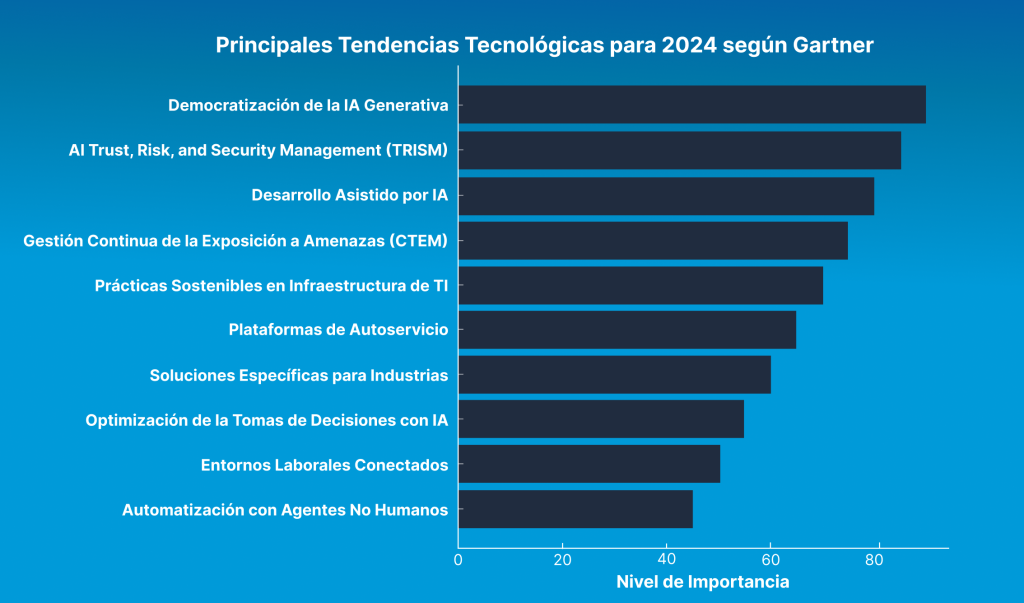
Democratization of Generative AI
Gartner predicts that by 2026, more than 80% of organizations will be using APIs and generative AI models. These technologies enable the automatic generation of content, the automation of repetitive tasks, and the improvement of user interactions through chatbots and virtual assistants. For example, a chatbot can efficiently handle customer service inquiries, freeing up time for internal employees to focus on more complex and strategic tasks.
AI Trust, Risk, and Security Management (TRiSM)
With the increasing adoption of AI, managing trust, risk, and security has become a much more relevant task. The reason? This process must ensure that implementations of this nature are trustworthy. In this way, Gartner highlights that companies that implement AI TRiSM controls in their workflows will significantly improve decision-making accuracy by eliminating false information from their databases.
AI-Assisted Development
Are you a digital product developer? AI-assisted development tools will be very important for your growth, as they will allow you to accelerate the product and service creation cycle, improving software efficiency and quality. As you may have guessed, this trend is key to maintaining competitiveness in a market where the offering seems to seek only one thing: differentiation.
Continuous Threat Exposure Management
It is essential to protect digital assets in an ecosystem where exposed surfaces are increasingly large. Strategies such as continuous monitoring, rapid incident response, and periodic vulnerability assessments are essential for protecting an organization's digital assets. Implementing CTEM involves using advanced security tools that can detect and respond to threats in real-time, minimizing the impact of potential unexpected events.
Sustainable Practices
This includes the use of energy-efficient data centers, optimizing energy consumption, and implementing recycling and e-waste management practices. Companies that adopt sustainable practices not only reduce their environmental footprint but can also benefit from cost savings and improve their corporate reputation.
Self-Service Platforms
Self-service platforms, such as GitHub Actions and GitLab CI/CD, improve productivity and reduce deployment times, allowing companies to be more agile and efficient in their daily operations. .
Integration of industry-specific solutions that improve flexibility and responsiveness.
Industry-specific solutions, such as AWS HealthLake for the healthcare sector or AWS Finspace for financial services, provide customized tools that address particular needs. These solutions enhance responsiveness and flexibility, enabling businesses to adapt quickly to market changes. For instance, HealthLake allows healthcare organizations to store, analyze, and extract insights from large-scale health data, while Finspace facilitates the management and analysis of complex financial data.
AI-Powered Decision Making Optimization
Tools like Google Cloud's BigQuery allow companies to quickly process and analyze large volumes of data, providing valuable insights that optimize decision-making and improve business operations. .
Interconnected work environments
Collaboration applications, such as Google Workspace and Microsoft Teams, facilitate a connected work environment, allowing for real-time communication and collaboration. These tools enhance productivity and efficiency, ensuring teams can work together regardless of their location. Furthermore, they integrate advanced features like video conferencing, real-time chat, and document sharing, creating a more dynamic and effective work environment.
Automation with Non-Human Agents
Non-human agents, such as chatbots on e-commerce platforms, automate purchasing processes and operations. These agents can make automatic purchases based on a user’s purchase history and preferences, improving efficiency and customer satisfaction. In addition, they can manage inventory, process returns, and handle technical support inquiries, reducing the workload on human staff and enabling companies to operate more efficiently and profitably.
Do you want to incorporate all of those technologies into your daily routine and boost your organization's growth? At Nublit, we can help you.
For over a decade, we've been cloud leaders in LATAM, working with companies of all sizes to empower their operations. Over 100 successful projects are the best proof of our professionalism. Contact us right now and let's schedule a meeting.


