
Google Cloud Platform: Everything You Need to Know

In addition, GCP excels at offering secure and reliable infrastructure, designed to meet the requirements of the most demanding applications. Because, yes, Google has invested heavily in the development of its global infrastructure, which guarantees low latency and high availability of its services. Likewise, GCP integrates perfectly with other company products, facilitating the creation of integrated solutions that leverage its full range of capabilities.
A Brief Tour of the History of Google Cloud Platform
Google Cloud Platform was launched in 2008 and initially had limited services and a lower adoption rate than its competitors. However, it has grown over time, adding a wide range of computing, storage, big data, machine learning, and artificial intelligence services, among others. Today, the platform stands out for its secure, highly available global infrastructure and for integrating tools that facilitate collaboration and innovation. Additionally, it offers scalable services, interoperability, and a strong commitment to sustainability and open source.

What are the differences between GCP, AWS, and Azure?
As we said in the introduction, Google Cloud Platform, Amazon Web Services (AWS), and Microsoft Azure are the three main cloud service providers in the market. Each has its own strengths and weaknesses, making them suitable for different types of companies and use cases.
- Amazon Web Services (AWS): AWS is the market leader, known for its broad range of services and robust ecosystem. It offers over 200 services and has pioneered cloud adoption.
- Microsoft Azure Azure is very strong at the enterprise level, especially for organizations that already use Microsoft products. It offers seamless integration with tools like Office 365, Copilot, and Active Directory.
- Google Cloud Platform (GCP) GCP excels in data analytics and machine learning, thanks to tools like Gemini, BigQuery, and Vertex AI. Its global network infrastructure is also among the most advanced, providing high speed and low latency.
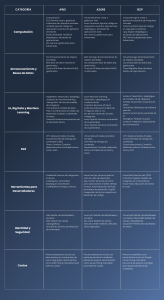
In this way, each platform has its own distinctive features. AWS is known for its breadth of services and its market maturity. Azure offers excellent integration with Microsoft solutions, making it ideal for companies that are already immersed in the Microsoft ecosystem. On the other hand, GCP stands out for its performance in big data and machine learning, as well as its high-quality network infrastructure. We're leaving you this note in case you want to dive deeper into the topic.
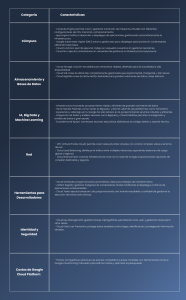
Las principales características y herramientas de Google Cloud Platform incluyen: **Características Principales:** * **Computación:** Ofrece una amplia gama de servicios para ejecutar aplicaciones y cargas de trabajo, incluyendo máquinas virtuales escalables, contenedores y funciones sin servidor. * **Almacenamiento:** Proporciona soluciones de almacenamiento escalables y duraderas para datos de todo tipo, desde objetos y bases de datos hasta archivos. * **Bases de Datos:** Ofrece una variedad de opciones de bases de datos, incluyendo bases de datos relacionales (SQL), NoSQL y bases de datos en memoria, diseñadas para diferentes tipos de aplicaciones y necesidades de rendimiento. * **Redes:** Permite construir redes virtuales seguras y escalables, con conectividad global y capacidades avanzadas de balanceo de carga y entrega de contenido. * **Big Data y Analytics:** Herramientas potentes para procesar, analizar y visualizar grandes volúmenes de datos, facilitando la obtención de información valiosa. * **Inteligencia Artificial y Machine Learning:** Servicios pre-entrenados y personalizables para implementar capacidades de IA y ML en aplicaciones, incluyendo visión artificial, procesamiento de lenguaje natural y aprendizaje automático. * **DevOps y Herramientas de Desarrollo:** Un conjunto de herramientas para automatizar el ciclo de vida del desarrollo de software, desde la codificación y la gestión de la configuración hasta la implementación y el monitoreo. * **Seguridad:** Funciones de seguridad integradas y herramientas para proteger datos y aplicaciones, incluyendo gestión de identidades y accesos, cifrado y monitoreo de seguridad. * **Gestión y Gobierno:** Herramientas para supervisar, gestionar y optimizar los recursos en la nube, asegurando el cumplimiento y el control de costos. **Herramientas Principales (Ejemplos):** * **Computación:** * **Compute Engine:** Máquinas virtuales IaaS (Infraestructura como Servicio). * **Google Kubernetes Engine (GKE):** Servicio gestionado de Kubernetes para orquestación de contenedores. * **Cloud Functions:** Computación sin servidor (serverless) para ejecutar código en respuesta a eventos. * **App Engine:** Plataforma como Servicio (PaaS) administrada para construir y desplegar aplicaciones web y móviles. * **Almacenamiento:** * **Cloud Storage:** Almacenamiento de objetos escalable y duradero. * **Persistent Disk:** Almacenamiento de bloques para instancias de Compute Engine. * **Filestore:** Almacenamiento de archivos NFS administrado. * **Bases de Datos:** * **Cloud SQL:** Bases de datos relacionales totalmente administradas (MySQL, PostgreSQL, SQL Server). * **Cloud Spanner:** Base de datos relacional globalmente distribuida que ofrece consistencia fuerte. * **Firestore:** Base de datos NoSQL de documentos escalable. * **Bigtable:** Base de datos NoSQL de alta capacidad y baja latencia para cargas de trabajo operativas y analíticas. * **Redes:** * **Virtual Private Cloud (VPC):** Redes virtuales seguras y aisladas. * **Cloud Load Balancing:** Balanceo de carga global para distribuir tráfico. * **Cloud CDN:** Red de entrega de contenido para acelerar la entrega de contenido web. * **Big Data y Analytics:** * **BigQuery:** Almacén de datos serverless, altamente escalable y rentable. * **Dataflow:** Servicio de procesamiento de flujos y lotes de datos gestionado. * **Dataproc:** Servicio gestionado de Apache Spark y Hadoop. * **Inteligencia Artificial y Machine Learning:** * **Vertex AI:** Plataforma unificada de machine learning. * **Vision AI:** Servicios para análisis de imágenes y videos. * **Natural Language AI:** Servicios para análisis de texto. * **AI Platform:** Entorno para construir, entrenar e implementar modelos de ML. * **DevOps y Herramientas de Desarrollo:** * **Cloud Build:** Servicio de integración y entrega continua (CI/CD) totalmente administrado. * **Cloud Source Repositories:** Repositorios Git privados alojados en la nube. * **Cloud Logging:** Servicio de registro de auditoría y monitorización. * **Cloud Monitoring:** Servicio de monitorización de rendimiento y disponibilidad. * **Seguridad:** * **Identity and Access Management (IAM):** Gestión de identidades y accesos. * **Security Command Center:** Plataforma centralizada de gestión de riesgos de seguridad y datos. * **Cloud Armor:** Protección contra ataques DDoS y aplicaciones web. Estas son solo algunas de las características y herramientas más destacadas. Google Cloud Platform ofrece un ecosistema extenso y en constante crecimiento de servicios para satisfacer una amplia gama de necesidades empresariales y tecnológicas.
Computing
- Compute Engine allows you to create and manage virtual machine instances with different CPU, memory, and storage configurations. This service offers flexibility and total control over the underlying infrastructure, ideal for workloads requiring custom configurations.
- App Engine: A PaaS service that facilitates application development and deployment. App Engine automatically manages the infrastructure, allowing developers to focus on code without worrying about server provisioning or scaling.
- Google Kubernetes Engine (GKE) A managed environment for deploying containerized applications using Kubernetes. GKE simplifies Kubernetes cluster management, offering features such as autoscaling, zero-downtime updates, and integrated monitoring.
- Cloud Functions allows you to run code in response to events without managing servers. This service is ideal for applications that require event-driven execution, such as processing uploaded files or responding to HTTP requests.
- Cloud Run: run containers without needing to manage the underlying infrastructure. Cloud Run offers the flexibility of containers along with the simplicity of the serverless environment, making it easy to deploy containerized applications quickly and scalably.
Storage and Databases:
- Cloud Storage: Scalable object storage solution designed for durability and high availability. Cloud Storage supports various storage classes for different data access needs, from frequent access to long-term archiving.
- Cloud SQL: Fully managed SQL database that supports MySQL, PostgreSQL, and SQL Server. Cloud SQL handles updates, patching, and backups, simplifying relational database administration in the cloud.
- Cloud Bigtable NoSQL database designed for large data volumes and low latency. Bigtable is ideal for applications requiring high write and read capacity, such as data analytics and IoT applications.
AI, Big Data, and Machine Learning:
Advanced Infrastructure: Google's global infrastructure enables fast and efficient processing of large volumes of data, which is essential for training AI and ML models.
2. Powerful Tools: GCP offers tools like Vertex AI, which simplifies the development and deployment of ML models, and BigQuery, which facilitates the analysis of large datasets. Additionally, platforms like TensorFlow, developed by Google, have become industry standards for machine learning.
3. AI Experience and Leadership: Google has pioneered AI, contributing significantly with advanced research and applications. This expertise translates into robust and efficient services on GCP.
4. Data Integration and Analysis: Services like BigQuery and Cloud Dataflow enable large-scale data integration and analysis, providing the necessary foundation for advanced AI and ML applications.
5. Support Ecosystem: Google offers numerous educational resources, open-source libraries, and technical support, making it easier for developers and businesses to adopt and use its AI and ML tools.
Red
- Virtual Private Cloud (VPC) allows the creation of virtual private networks. VPC offers complete control over the network environment, allowing configuration of subnets, firewall rules, and routing policies. This provides a secure and isolated environment for deploying applications and services, ensuring detailed control over network topology.
- Cloud Load Balancing: distributes traffic across multiple instances. This service supports global and regional load balancing and can automatically scale to handle traffic surges. Cloud Load Balancing also offers HTTP(S), TCP/SSL, and UDP load balancing, providing high availability and optimal performance for applications.
- Cloud Interconnect Connects on-premises infrastructure with Google Cloud, providing dedicated and secure connectivity options. Cloud Interconnect enhances network performance and reduces data transfer costs. It offers options such as Dedicated Interconnect and Partner Interconnect, enabling low-latency connections between on-premises infrastructure and Google Cloud.
Developer Tools
- Cloud Scheduler: It schedules automatic tasks, allowing jobs to be executed periodically and reliably, similar to cron in Unix systems. It's ideal for automating maintenance jobs, such as database cleanups and system updates.
- Artifact Registry manages container images. This service allows you to store, manage, and secure Docker container images. Integrated with Google Kubernetes Engine (GKE) and other GCP services, it facilitates the continuous deployment of containerized applications.
- Cloud Tasks: Executes tasks in a queue. It provides a scalable and reliable way to manage the execution of asynchronous tasks. It is ideal for decoupling application components, improving scalability and resilience.
Identity and Security
- Cloud Key Management Manages cryptographic keys. Allows creation, usage, and management of keys for encrypting stored and in-transit data. Integrates strict security policies and detailed access controls to protect cryptographic keys.
- Cloud Data Loss Prevention: Protects sensitive data against leakage. This service identifies and protects sensitive information, such as credit card numbers and personal data, using data discovery and classification techniques. It facilitates compliance with privacy and security regulations.
What is the cost of Google Cloud Platform?
GCP offers competitive storage pricing, although its pricing structure can be complex and vary based on usage. Costs include egress fees and operations within servers, which require careful planning to avoid unexpected expenses. GCP provides tools such as the Google Cloud Pricing Calculator to estimate costs and optimize the budget based on the specific needs of each project.
Google Cloud Platform: a platform to consider
Google Cloud Platform (GCP) has established itself as one of the leading cloud service providers through its global infrastructure, advanced data analytics and machine learning capabilities, and integration with other Google services. GCP offers a wide range of services including compute, storage, databases, networking, developer tools, and security and identity solutions. Its secure and highly available infrastructure, along with tools like Vertex AI, BigQuery, and TensorFlow, make GCP an attractive option for businesses of all sizes seeking a robust and scalable cloud platform.
Compared to other providers like AWS and Azure, GCP stands out for its focus on big data and machine learning performance, as well as its advanced network infrastructure. Meanwhile AWS offers a wide range of services and is known for its market maturity, and Azure stands out for its excellent integration with the Microsoft ecosystem. GCP excels in data analytics and artificial intelligence, providing innovative and efficient solutions for its users.
With a competitive pricing structure and tools for estimating and optimizing costs, GCP also facilitates the financial management of cloud projects, ensuring that companies can scale their operations profitably. In summary, Google Cloud Platform is a powerful and versatile platform that can meet the needs of modern businesses looking to leverage the latest cloud technologies.
Are you interested in the platform? Nublit is your ideal partner to take advantage of all its benefits. For over a decade, we've helped companies and organizations of all sizes enjoy all the advantages that the cloud offers.


